




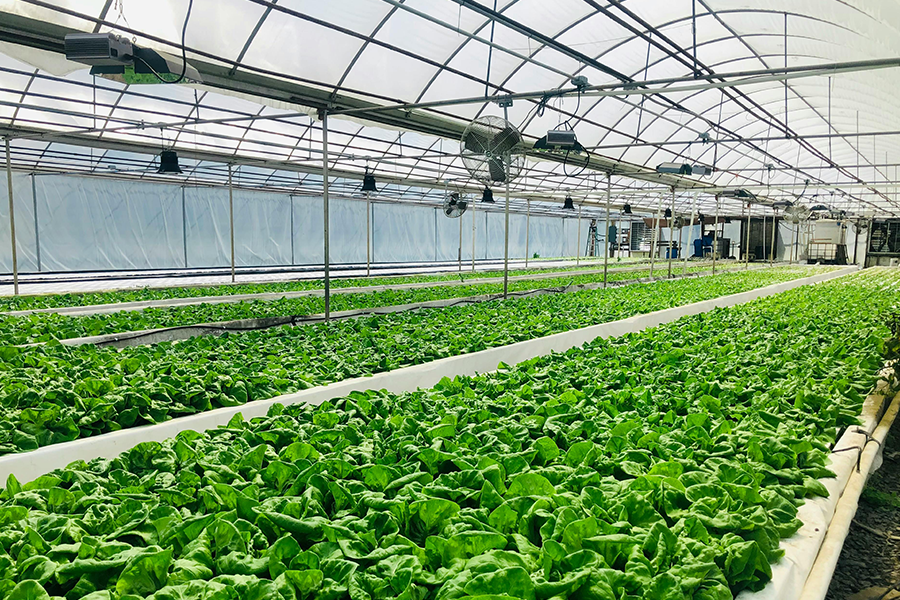

High Performance Hot-Dip Galvanized Greenhouse Structural Supports Guide
Publish Time:2026-10-29 09:34:53 Author:Jucheng Views:189
Introduction
The frame of a greenhouse is asked to do something unusual: remain dimensionally stable outdoors for two decades while carrying a moving load from wind, snow and a tensioned covering. That combination makes material selection the single most consequential decision in the whole project. Among the available options, the hot-dip galvanized greenhouse frame remains the reference solution for commercial structures.
The reason is not simply that zinc looks clean on delivery day. Hot-dip galvanizing creates a metallurgical bond between coating and steel, and crucially it is sacrificial: exposed zinc corrodes in preference to the substrate, protecting cut ends, drill holes and installation scratches long after the structure is erected.
This guide covers how galvanized structural supports behave under load, which coating mass to specify for which climate, and where corrosion still begins even on a well-galvanized frame.
What Hot-Dip Galvanizing Actually Does
In a hot-dip bath, cleaned steel is immersed in molten zinc at roughly 450 degrees Celsius. The reaction produces a series of zinc-iron alloy layers topped with a layer of relatively pure zinc. Those alloy layers are harder than the base steel, which is why a galvanized tube resists the abrasion of film movement and handling better than painted tube.
The practical consequence is protection at the edges. A painted tube that is drilled on site exposes bare steel at the hole; a galvanized tube exposes zinc, and the surrounding coating sacrificially protects that point. For a structure assembled from hundreds of clamped joints - each one a potential scratch - this property matters more than any laboratory salt-spray figure.
Specifying Zinc Coating Mass by Climate
Coating mass is measured in grams per square metre, and it is the number that should appear on every purchase specification. Specifying 'galvanized' without a number invites the thinnest coating a supplier can produce.
| Project environment | Recommended zinc coating | Indicative service life | Notes |
|---|---|---|---|
| Inland, low humidity, single season use | 60-100 g/m2 | 8-12 years | Suited to temporary tunnels |
| Inland, year-round commercial production | 120-180 g/m2 | 15-20 years | Standard for vegetable tunnels |
| High irrigation humidity, heated glasshouse | 180-275 g/m2 | 20+ years | Condensation is the dominant risk |
| Coastal or salt-laden air | 275 g/m2 and above | 20+ years | Consider aluminium for small fittings |
Hot-Dip, Pre-Galvanized and Painted Steel Compared
Pre-galvanized sheet is coated at the mill before forming, which produces a thin, uniform layer. It is adequate for light-duty fittings but the coating is stretched at formed corners, and cut ends remain unprotected. Painted steel gives an attractive finish and nothing else once the film is scratched.
For structural members that carry load, the corrosion resistant greenhouse structure argument favours hot-dip: coating thickness at corners is actually greater than on flat surfaces, and the alloy layers resist mechanical damage during transport and erection.
How Structural Supports Carry Wind and Snow Load
A greenhouse frame works as a system rather than a set of independent tubes. Uplift from wind enters the covering film, passes into the lock channel or clip, and travels through the purlin into the arch and then to the foundation. Snow load pushes in the opposite direction, but through the same path.
This is why a greenhouse steel framework must be specified as a matched set. An oversized arch tube paired with a light-gauge purlin simply relocates the failure to the purlin. A proper specification sets tube diameter, wall thickness, purlin spacing and clamp gauge together, then validates the assembly against the local design wind speed and snow load.
Arch tube and column - the primary members; wall thickness drives both bending capacity and clamp grip.
Purlin and ridge member - distributes covering load and stabilises the arch against lateral buckling.
Bracing and diagonal tie - resists the racking that turns a wind gust into a progressive collapse.
Base plate and anchor - the final transfer point into the soil, and the most commonly under-specified element.
Where Corrosion Still Starts on a Galvanized Frame
Galvanizing is not invincible. Three details account for most of the corrosion seen on otherwise sound structures, and all three are design or installation issues rather than coating defects.
First, crevices. Overlapping plates, badly seated clamps and standing water in a gutter create oxygen-starved pockets where the zinc layer is consumed faster than elsewhere. Second, contact with dissimilar metals - a bare copper or uncoated steel fastener against galvanized tube sets up a galvanic couple that strips the zinc locally. Third, mechanical damage during erection; dragged tubes and impact-wrenched clamps remove coating at exactly the points that later carry the highest load.
Specifying matching galvanized fasteners, sealing overlaps, detailing gutters to drain freely and handling tubes with slings rather than chains addresses all three at effectively zero material cost.
Maintenance and Inspection Intervals
A galvanized frame requires little maintenance, but 'little' is not 'none'. An annual inspection focused on connection points, base plates and gutter interiors catches problems while they are cosmetic. Where scratches have exposed the substrate, a zinc-rich cold galvanizing compound restores sacrificial protection without dismantling the joint.
Record the coating mass and installation year at handover. Knowing the specified baseline makes later condition assessments objective rather than impressionistic, and it gives replacement budgeting a defensible number.
Conclusion
Structural performance in protected cultivation is a coating problem as much as a section-property problem. A hot-dip galvanized greenhouse frame with a coating mass matched to the site climate, assembled with compatible fasteners and detailed to avoid crevices, is the lowest-risk way to secure two decades of production from a single investment.
Where spans, heights or coverings fall outside standard ranges, customized greenhouse parts produced to the same galvanizing standard keep the load path consistent from the base plate to the ridge.
Related News
-
High Performance Hot-Dip Galvanized Greenhouse Structural Supports Guide
This guide explains how hot-dip galvanized structural supports carry wind and snow loads in a greenhouse, what zinc coati...
-
Customized Greenhouse Parts: A Practical Guide to OEM Structural Components
A buyer's guide to customized greenhouse parts and OEM components: when a standard catalogue stops fitting, what informat...
-
Reliable Greenhouse Accessories Manufacturer Guide for Commercial Growers
A practical guide for commercial growers on how to evaluate a greenhouse accessories manufacturer, covering material grad...
-
Greenhouse Single Pulleys: How to Choose a Reliable Pulley for Hanging and Lifting
A single pulley lifts and redirects loads in a greenhouse. Learn how the single pulley is built, where it fits, and how t...
-
Greenhouse Reversing Wheels: How a Small Part Keeps Side Film Winding Reliable
A reversing wheel redirects film-winding force so your side coiler works smoothly. Learn how the reversing wheel is built...